

 Leadership and Psychological Safety shape what people dare to say, try, admit, and challenge — every single day.
Behind every team is an invisible question people are constantly asking themselves:
“Is it safe for me to be myself here?”
Leadership is not just about goals, plans, or execution. It quietly shapes the emotional climate of a team.
It silently teaches people what is safe and what is risky.
Over the last 25 years each, Nev and I have been working with leaders and teams of every culture, sector, role and organization type, to find quality solutions to these very important topics. And while there are quality best practices to know, learn and apply all around, there are a myriad of ways to making it especially relevant, effective and meaningful in any given situation.
No matter what your professional or personal situation, opportunities to give and recieve leadership have likely been made available to you. And as a result, you’ve no doubt lived the impact of how good quality OR ineffective leadership – your own or from others – has impacted your desired results, objectives and experience.
So this post is for EVERYONE.
And we hope it will bring you value – we look forward to your thoughts.
Leadership and Psychological Safety, let’s get on the same page about what we’re talking about…
Two well-known frameworks help illuminate these concepts and the connection between them:
- Situational Leadership – developed by Paul Hersey and Ken Blanchard, reminds us that people don’t need the same kind of leadership at every stage. Sometimes they need direction. Sometimes support. Sometimes space. The leader needs to adapt their way of thinking, working and treating others depending on the best way to support them and the completion of identified objectives, at any moment. It might seem complex at first, but with time and practice, it becomes natural.
- Psychological Safety – articulated by Timothy Clark, describes how safety itself evolves from belonging, to learning, to contributing, to challenging. By aligning Situational Leadership stages with the four stages of Psychological Safety, leaders can offer the right kind of safety at the right moment in a team’s development.
Put simply, Situational Leadership focuses on what leaders do, while Psychological Safety focuses on what people feel safe doing.
When these two frameworks are understood and intentionally connected, leadership becomes both effective and humane.
For a deeper reflection on leadership, psychological safety, and compassion, you may also enjoy this earlier NEVBlog “Leadership, Psychological Safety & Compassion: A Pup’s Journey” exploring these themes through a more personal lens.
Leadership and Psychological Safety: Stages and Types of Safety Needed
1. The Directing Stage of Situational Leadership
The Directing Stage happens when people or teams are new. The essential need here is Inclusion Safety – the quiet reassurance: “You belong here, even if you don’t know much yet.”
People don’t yet understand the rules, the language, or what “good” looks like. They are watching closely, not just for instructions, but for signs of acceptance.
Inclusion Safety is built less through inspiration and more through predictability and care.
Leaders at this stage:
- Explain how things work without making people feel small for not knowing.
- Say out loud what newcomers are often afraid to ask: “If you’re confused, that means onboarding is working.”
- Invite quieter voices in: “You’re seeing this with fresh eyes – what stands out to you?”
What this prevents is early silence, self-censorship, and the quiet conclusion: “I’d better stay careful here.” At this stage, belonging comes before performance.
TIP: A personal practice I developed is to intentionally have at least a moment of true contact in every meeting with every team member. Particularly with the new ones. Unconditional appreciation as a person allows people to start performing.
This doesn’t need to be long at all. Sometimes just looking in the eyes, a genuine smile or a brief touch is enough but this really helped people feel seen and accepted unconditionally.
And in online meetings it takes the form of the same but without physical interaction, just asking a bit about each person and listening and responding with care, can be enough. It’s incredible how well it works and often immediately, creating an atmosphere where every person feels seen, heard and recognised. Before you realize, others in the moment will start doing the same.
2. The Coaching Stage of Situational Leadership
As teams move into the Coaching Stage, the core need becomes Learner Safety – the permission to learn out loud.
Competence grows, but confidence often wobbles. People begin to see the complexity of the work and their own gaps. This is where many teams tighten up just when they should open.
Learner Safety tells people they won’t be judged for not being perfect.
Leaders at this stage:
- After a mistake, asks before judging: “What did you try? What were you thinking at the time?”
- Normalize struggle by sharing their own: “I missed this the first few times too.”
- Focus feedback on growth, not worth: “This part is solid. This part is still forming.”
What this prevents is defensiveness, hiding errors, and learning in private instead of together. Here, the leader makes one thing clear: learning is not a detour – it is the work.
TIP: I learned that people need to feel their leader as human and capable of showing vulnerability to really dare speak and try new things.
Showing yourself rock solid and having all answers will stop your team’s growth.
But opening up about your own growth and leadership challenges, showing empathy, sympathy and compassion around the learning process, helps people feel that their own experience is normal and ok. Even if they have important things to course correct for improvement and better results.
3. The Supporting Stage of Situational Leadership
In the Supporting Stage, the emotional task shifts again. Now people are capable, but capability doesn’t automatically turn into confidence. Visibility feels risky. Ownership feels exposed. Contributor Safety is not assumed; it must be actively invited.
Leaders at this stage:
- Step back deliberately and say, “You have more context than I do – how would you approach this?”
- Loosen authority on purpose: “You don’t need my approval. I trust your judgment.”
- Protect ideas before they’re evaluated: “Let’s hear it fully before we critique it.”
This prevents talented people from playing small, waiting to be told, or contributing only what feels safe. At this stage, leadership becomes less about answers and more about permission.
TIP: When a person truly believes in you this can make miracles.
But not giving people enough space will keep them comfortably dependent and frustrated as they will not grow, evolve and mature as they and you need them to do.
The key is finding a “sweet spot” of guiding their growth while giving them enough space to learn, contribute and change on their own.
4. The Delegating Stage of Situational Leadership
Finally, in Delegating Stage, the deepest form of safety comes into play: Challenger Safety – the assurance that truth will not be punished, even when it’s uncomfortable.
When teams are strong, the greatest risk is no longer failure but silence: unspoken doubts, polite agreement, innovation that never quite happens.
Leaders at this stage:
- Invite disagreement explicitly: “Before we decide, who sees this differently?”
- When challenged, they respond with curiosity rather than authority: “Say more. What are we missing?”
- Thank people who surface hard truths, even when it slows things down.
This prevents groupthink, quiet disengagement, and “yes” that really means “no.” At this stage, trust is proven not by harmony, but by how disagreement is held and managed towards ever better solutions.
TIP: Challenge feels uncomfortable but is often a sign of true committment. That is why it is so powerful to meet it with gratitude and curiosity.
Naturally, there are always pressures for results and in the day-to-day.
But engaging the entire team to cover known and unknown blindspots and together come up with ever better solutions (which will likely not be the first ones) will create better and more resilient results, and a mindset in your people that continually challenges them to go beyond the expected.
Leadership and Psychological Safety in Everyday Leadership
There is a quiet truth about Psychological Safety: it is not something leaders declare. It is something people infer from dozens of small moments – who gets interrupted or left out, how mistakes are handled, whether dissent is welcomed or remembered later, the comfort to speak up and offer ideas that are different and perhaps unexpected or initially undesired.
And much more.
As leaders it is easy to be very focused on outcomes while forgetting the individuals and teams development stages and safety needs.
Situational leadership gives teams structure.
Psychological safety gives that structure soul.
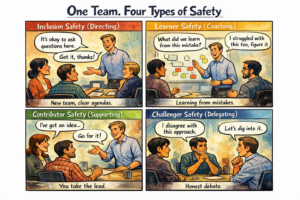
When the two evolve together, teams don’t just perform better. They become places where people can think clearly, speak honestly, and grow without armor.
And that may be the most sustainable advantage a leader can create.
If you’d like to explore further why feeling safe is so essential for trust, collaboration, and performance, this TED Talk by Simon Sinek closely aligns with the ideas we’re discussing here.
Leadership is not only what we ask of people, but what we make safe for them to give.
Take a moment to reflect on where you might be offering clarity, permission, or space — and where one small shift could make a meaningful difference.
If this resonates, we’d love to hear your thoughts.
Thanks for taking a moment to share.